

10 Things You Need to Consider When Starting Homeschooling
Homeschooling.
The word alone can stir up a whirlwind of emotions—freedom, overwhelm, excitement, fear, curiosity, and maybe a little doubt. You’re not alone.
Whether you’re drawn to homeschooling because of its flexibility, the promise of more family time, or a desire to give your children a personalized, holistic education—starting can feel like drinking from a firehose. But here’s the truth no one tells you: You don’t have to do it all at once. You just have to start. And this post will walk you through everything you actually need to consider as you take the leap.
Know Your “Why” (and Revisit It Often)
Your “why” becomes your anchor when you hit rough days (and you will).
Is it:
- More time together as a family?
- A faith-based approach?
- Avoiding the stress or pace of traditional schooling?
- Your child’s unique learning needs?- More freedom and flexibility?
Write it down. Frame it. Tattoo it on your soul.
How to Start:
- Journal your homeschool “mission statement.”
- Talk to your partner or support system about your goals and values.
- Keep this why visible—in your planner, your school area, or your heart.
Research Your State’s Legal Requirements
Homeschooling is legal in all 50 states, but the rules vary widely.
Key Things to Find Out:
- Do you need to file a notice of intent?
- Are there attendance, subject, or hour requirements?- Do you need to submit assessments or evaluations?
- What records do you need to keep?
How to Start:
- Visit hslda.org to find your state’s homeschool laws.
- Join a local homeschool Facebook group.
- Consider joining a legal defense organization.
Understand Your Child’s Learning Style
Not every child thrives sitting at a desk with a workbook.
Main Learning Styles:
- Visual: Needs charts, images, and videos.
- Auditory: Learns best through songs, conversations, or read-alouds.
- Kinesthetic: Learns by doing.
- Reading/Writing: Prefers worksheets and books.
How to Start:
- Observe how your child plays and explores.
- Try a learning style quiz
.- Choose materials aligned with their strengths.
Choose a Method That Resonates with Your Family
You don’t have to recreate public school at home.
Popular Homeschool Methods:
- Charlotte Mason
- Classical- Unit Studies
- Unschooling
- Eclectic
- Traditional
How to Start:
- Read up on methods.
- Watch day-in-the-life videos.
- Try one for a month and adjust.
Start with the Basics (You Don’t Need Everything Right Away)
You only need a few core subjects:
- Reading- Writing- MathHow to Start:
- Pick one subject to start with.
- Use free resources.
- Add more gradually.
Set a Daily Rhythm (But Stay Flexible)
A rhythm helps create stability.
Sample Daily Rhythm:
- Morning Basket
- Core Work- Outdoor Time
- Read-Aloud- Creative Time
- Quiet TimeHow to Start:
- Observe natural family patterns.
- Build rhythm around meals and naps.
- Be open to shifts.
Find (or Build) Your Homeschool Community
Homeschooling can feel isolating.
Why It Matters:
- You need support.
- Kids need friends.
- Real-life encouragement is vital.
How to Start:
- Attend one event.
- Host a park day
-Join a Facebook group
-Find a local co-op
- Connect with one homeschool parent.
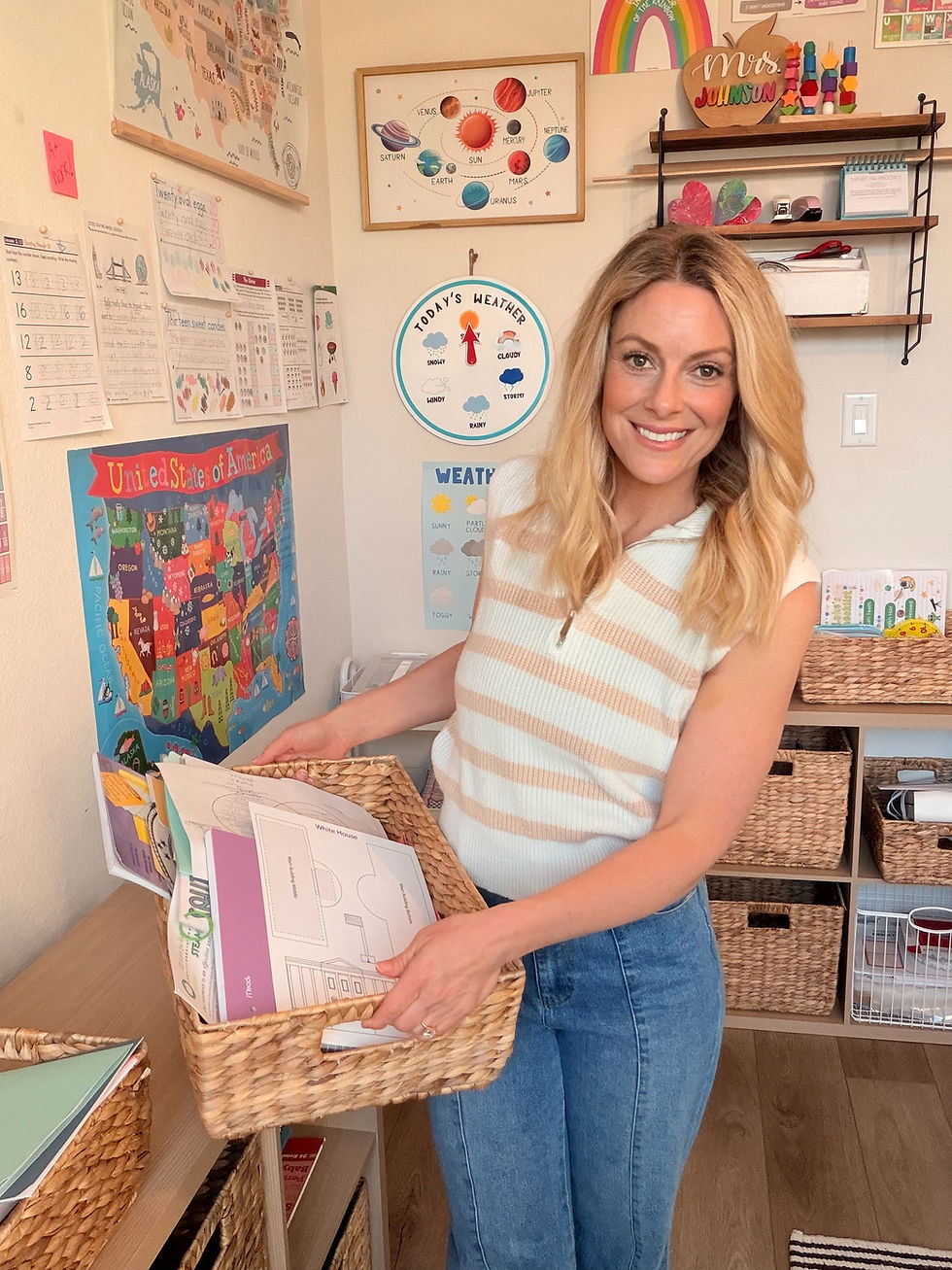
Create a Learning Environment (It Doesn’t Have to Be a “School Room”)
Learning happens everywhere.
Tips:
- Use baskets for supplies.
- Keep the space intentional.
- Rotate materials.
How to Start:
- Designate learning and reading spots.
- Display kids' work.
- Implement a reset routine.
Know That Curriculum Isn’t Everything
The best curriculum is what works for your child, and that may be a blend of different programs / curriculum.
Things to Consider:
- Learning style alignment
- Teacher involvement
- Faith-based vs. secular
- Return policy
How to Start:
- Use free samples.
- Explore resale options.
- Ask for recommendations.
You Will Grow As Much As Your Kids
Homeschooling grows you too. You’ll learn to slow down, manage conflict, embrace play, trust your intuition. You’ll celebrate wins and release perfection. That’s what makes it beautiful.
Don’t Forget about Assessments
Regardless of what you hear, assessments (both formal and informal) are important. Even if you want to avoid standardized test taking due to fear of “comparison”, you can assess your child in other ways. This type of information gives you nothing but insight and perspective about what areas you need to work on. Trust me, assessment is necessary! Let’s break it down…
Standardized Assessments
(Norm-referenced, comparable to peers nationwide — optional for most homeschoolers, required in some states)
These are usually used 1x per year or as needed.
Common Standardized Tests
• Iowa Assessments (ITBS)
• Stanford Achievement Test
• TerraNova
• CAT (California Achievement Test)
• MAP Growth (adaptive, online)
• Woodcock-Johnson Tests of
Achievement
• WIAT (Wechsler Individual Achievement Test)
What they measure:
Reading, math, language, spelling, sometimes science/social studies
Why homeschool moms use them:
✔ State compliance
✔ Benchmarking
✔ Identifying learning gaps or strengths
✔ Documentation for transfers or services
💡 Tip: These are not required in many states and are just one snapshot—not the full picture.
Formal (Non-Standardized) Assessments
(Structured, criterion-based, teacher-led — great for portfolios & progress tracking)
These are assessments you administer regularly.
Academic Assessments
Unit tests & chapter tests
End-of-lesson quizzes
Curriculum-provided assessments
Timed math fact tests
Reading comprehension tests
Spelling tests
Writing rubrics (sentence → paragraph → essay)
Skill-Based Assessments
Reading level inventories
Fluency checks (words per minute)
Math computation checks
Dictation exercises
Grammar checks
Copywork evaluation
Developmental & Functional
Fine motor skill checklists
Handwriting rubrics
Oral language samples
Executive functioning checklists
Why homeschool moms love these:
✔ Easy to track growth
✔ Aligned to your curriculum
✔ Great for portfolios
✔ Flexible & low pressure
Informal Assessments (The Homeschool Superpower)
(Observation-based, daily, authentic — often the most accurate)
These happen every single day, whether you realize it or not.
Observation-Based
Watching your child read aloud
Listening to narration
Monitoring problem-solving strategies
Observing frustration tolerance
Noting independence vs. prompting needed
Performance-Based
Projects
Presentations
Oral reports
Experiments
Demonstrations
Role play
Teaching a concept back to you
Work Samples
Writing samples over time
Math notebook work
Drawings with labels
Science journals
Reading logs
Copywork progression
Discussion & Conversation
Socratic questioning
“Tell me how you solved this”
Retelling stories
Explaining cause & effect
Predicting outcomes
Daily Living & Life Skills
Following multi-step directions
Time management
Chore completion
Organization
Emotional regulation
Social interactions
💡 Important: These assessments often show more growth than any test ever could.
Portfolio Assessments
(Perfect for homeschool documentation & state requirements)
A portfolio can include:
Work samples (beginning/middle/end of year)
Photos of projects
Reading lists
Writing progressions
Math skill checklists
Teacher notes
Student reflections
✔ Shows growth over time
✔ Child-specific
✔ Flexible
✔ Parent-led
Parent-Created Mastery Checklists
(One of the BEST tools for homeschool moms)
You can track:
✔ Skills mastered
➜ Skills in progress
○ Skills not yet introduced
Examples:
Reading skills checklist
Math skills progression
Writing milestones
Science process skills
Executive functioning skills
Behavior/self-regulation goals
Student Self-Assessment (Highly Underrated)
Especially powerful for 1st grade and up.
“What was easy today?”
“What was tricky?”
“What do you want to practice more?”
Goal-setting pages
Reflection journals
Emoji or color-coded reflections
✔ Builds ownership
✔ Encourages metacognition
✔ Supports independence
Big Takeaway (This Matters ❤️)
Homeschool assessment is not about testing.
It’s about tracking growth, guiding instruction, and knowing your child deeply.
Most homeschool moms use a blend:
✔ Informal daily assessment
✔ Formal curriculum checks
✔ Optional standardized testing for documentation

--------BONUS ONLINE TIPS-------
10 Online Resources That Make Homeschooling Easier (and More Fun)
Time4Learning
Best for: PreK–12th grade, full curriculum
Offers animated, self-paced lessons across all subjects. Great for independent learners or busy seasons.
One Minute Reader
Best for: Early reading fluency
Short stories, read-aloud tracking, and fluency practice. Ideal for new readers.
IXL
Best for: Math and language arts, K–12
Adaptive practice with instant feedback. Reinforces and tracks mastery.
SplashLearn
Best for: Fun math/reading for PreK–5
Game-based practice that makes learning feel like play.
Outschool
Best for: Live classes and interests
Thousands of teacher-led classes—math, art, science, even Minecraft history!
Khan Academy
Best for: Free instruction in all subjects
Video tutorials, quizzes, and progress tracking. Great for budget-friendly support.
TypingClub
Best for: Learning to type
Full typing curriculum with interactive games and lessons.
Prodigy
Best for: Math through gaming
Solves math problems while playing an adventure game. Kids love it.
Epic!
Best for: Digital book access
40,000+ read-to-me books, audiobooks, and chapter books.
BrainPOP
Best for: Animated science/social studies
Videos, quizzes, and hands-on extensions that simplify complex topics.
A final word, mama 🤍
If no one has told you lately—you’re doing a really good job.
Homeschooling isn’t about checking every box or proving anything to the world. It’s about showing up, day after day, choosing connection over perfection, growth over comparison, and your child over the noise.
Some days will feel full and flowing. Others will feel messy, loud, and unfinished. Both count. Both matter. Learning is happening in the quiet breakthroughs, in the hard moments, in the conversations you don’t even realize are shaping your child’s heart and mind.
Trust your instincts. You know your child better than anyone ever could. You are not behind. You are not failing. You are building something meaningful—one lesson, one read-aloud, one deep breath at a time.
Keep going. Keep leading with intention. And remember: this season, this calling, this work you’re doing at home—it matters more than you know.
You’re not alone. And you were made for this.
Got homeschool questions? Drop them below, and I'll do my best to answer them. As a previous public school teacher with an extensive experience in special education, I thrive off sharing any tips and tricks for homeschool moms. Let's set our kids up for success!
Warmly, Jenna
Find me on Pinterest: Teach, Create, Thrive
Shop my Homeschool Printables: Learning Activities
#homeschool #printables #education #assessments #homeschoolmom #specialeducation #teacher #teach #teachcreatethrive


Comments